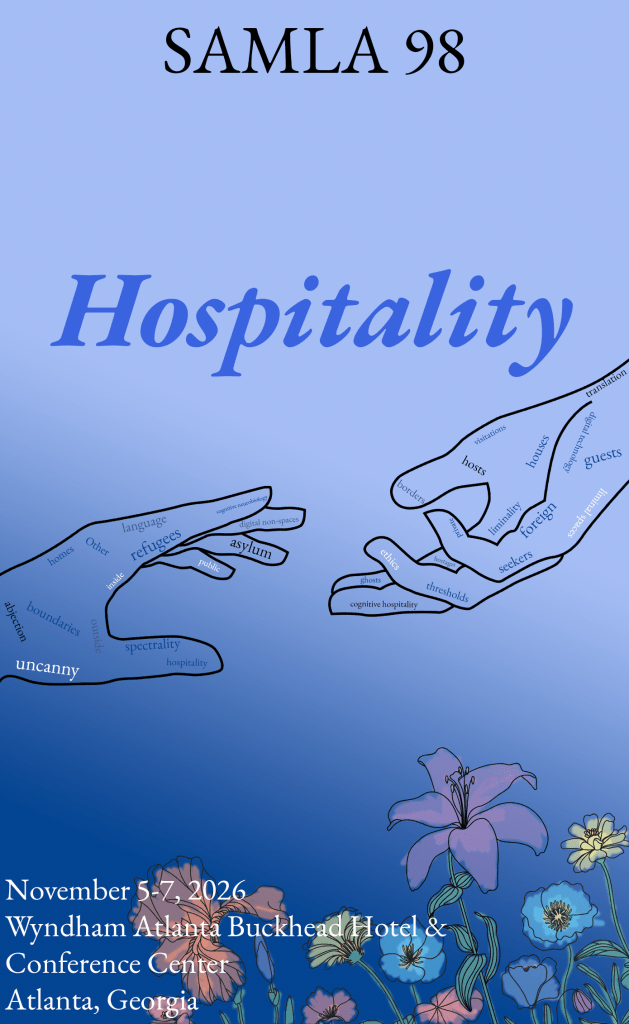
SAMLA 98: Hospitality
We may imagine the act of hospitality benign: to open a door, to welcome another across a threshold, or to make an offer to a guest. Rooted in such acts, however, is an ethics of how we engage with another, whether friend or stranger. Acts of hospitality contain their own contradictions, as to serve as host is to hold power, to set terms, to guard thresholds and entry points. For this year’s SAMLA conference, we invite papers, panels, and creative works that consider the many meanings and complications of hospitality—as practice, metaphor, ethics, affect, and structure. As SAMLA begins to look forward to its centennial, and thereby backward at its near-century of fostering academic collegiality and exchange, a focus on Hospitality affords a consideration of the encounters that go, so often, undertheorized.
Hospitality’s rich lexicon–including invitation, welcome, accept, reception, but also hostage, hospital, and hostile–and ethos encourages us to consider borders and boundaries; thresholds and liminal spaces; homes, houses, the uncanny, and being at-home; and to hink deeply about those who find themselves unhomed, displaced, or transient. It raises questions about the host and the guest, the public and the private, belonging and exclusion, generosity and abjection, foreignness and the Other. From Jacques Derrida’s assertion that “the question of translation is always a question of hospitality” to a consideration of hosts/hospitality in a biological sense (in the case of viruses, parasites, and the immunological dimensions of a host), and the intrusive dis/locations of digital technologies, this year’s theme invites consideration of all forms of hospitality. How might we understand readers as guests, being neither fully inside nor outside the text? Or ghosts and spectrality as extending the bounds of hospitable acts? How does hospitality function in the contexts of asylum, refuge, exile, migration, or colonial encounter? What does it mean to offer–or withhold–welcome, whether as individuals, as institutions, as nations, or as texts?
We hope that the capaciousness of this theme will invite a wide range of approaches and voices, from literary and cultural analysis to creative works, studies in medical humanities, digital technologies, and beyond.
Possible topics include but are not limited to:
- Hospitality and the ethics of encounter;
- Home, exile, unhoming, and transience;
- Borders, boundaries, and liminal or in-between spaces;
- Hosts, hostesses, guests, and power;
- Subjectivity and ipseity;
- Places of public hospitality, including hospitals, hostels, and hotels;
- Crimes of hospitality;
- Translation, language, and linguistic hospitality;
- The digital, the virtual, and non-places;
- Religious traditions of hospitality;
- Cognitive and neurobiological perspectives on openness and receptivity;
- The uncanny, ghosts, mourning, and spectrality;
- Hospitality and/as pedagogy;
- Refuge, asylum, and migration;
- Citizenship, non-citizenship, intruders, and belonging;
- Geographic or regional conceptualizations of hospitality (e.g. Southern Hospitality);
- Animal, non-human, cross-species, and posthuman hospitality;
- Tourism and the hospitality industry;
- Reading and interpretation as hospitable acts; and
- Gendered, racialized, and classed dynamics of hospitality.